I always feel like Somebody's watching me: Privacy online
There has been a lot of discourse surrounding online privacy as of late. But we can't forget that this conversation was being had in the early stages of the internet. In its infancy, privacy applied to personal information that the user would typically give out themselves (anyone remember A/S/L?). Now we have to be concerned with more than just the information that we willingly share. It has been known that private information is being collected through various social media accounts, which then influence personal content that users interact with.
We've often made the joke "Is Alexa/Siri listening to me?" when an AD or post about a previously discussed topic sometimes ends up on your timeline. We are all connected to the web, through smartphones, watches, and even household appliances all in the guise of making everyday life convenient.
We even saw in this newest season of Love is Blind Jeramey got caught red-handed in a lie in 4k because of geolocation.

"I was in the parking lot with her (Sarah Ann) until 5AM. You can check my location I shared it with you" said Jeramey the lying liar that lies. Completely forgetting that he also has an Apple Watch that ALSO tracks his location.
.jpg)
Admittedly, this was rather clever, had he not fumbled at the End Zone. Diabolical, but clever for someone who got thoroughly dragged by the entire audience of this show, as well as the woman he was engaged to.
"Kick rocks with open-toed shoes" is an ICONIC line that will live forever in my lexicon. But I digress.
Because we are connected to the world at every instant, some of the information collected can feel like an invasion of privacy. Buzzfeed News reporters looked into the information Facebook has collected. The company released a tool that can showcase the online activities of users beyond just Facebook. Many web pages that allow for account creation will have the option to do so by linking your social media or your email. According to the sources cited in the Buzzfeed article, early a third of all websites include a Facebook tracker. Because of this, Facebook can track what users utilize Facebook for as well as other visited websites.
This often is the reason why that after visiting certain websites, or even googling something influences the content that appears on individual feeds. There are options for users to manage external browsing data, such as clearing the history but does this completely delete that information entirely? No, instead of pairing the information with the account of the user, they just make the data anonymous. This is not something I had a grasp on. I understood to some extent the algorithm. However, it is with this article that I learned that privacy and algorithms are somewhat symbiotic.
Facebook was nowhere near the first social media platform to flourish, despite its wide reach now 24 years after its initial launch. They were still competing with platforms like Myspace
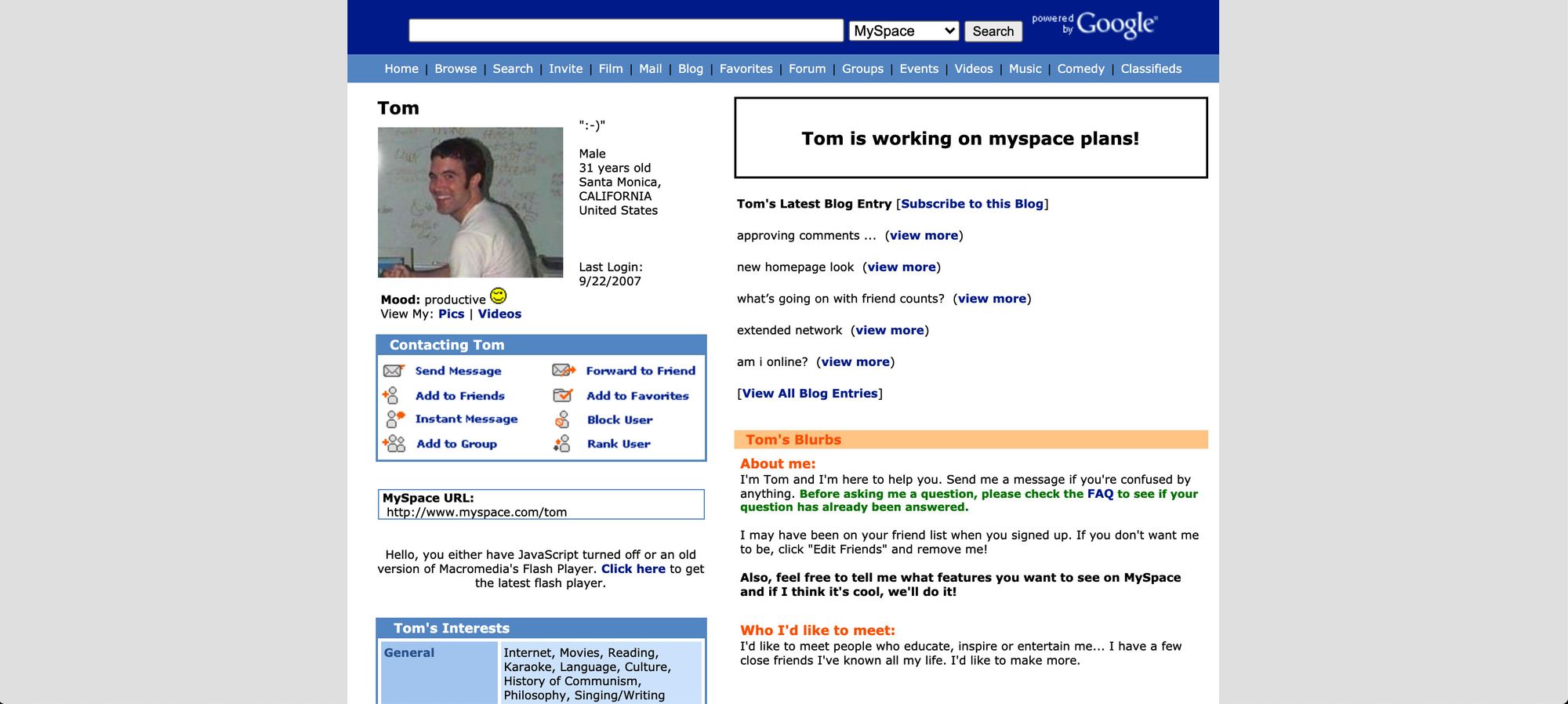

(Image Source: Buzzfeed via Forever Twenty Somethings Blog)
Myspace felt like a place of community that millennial teens carved out on the web. On the one hand, we were being warned by adults to not post photos of ourselves online or incriminating information about our identity. While we didn't heed any warnings - because let's admit it, we walked so Facebook could run - the profiles that I knew of were heavy on vague posting. The example above shows someone who has more information about themselves, but a lot of profiles I frequented were more vague on their profile. All the while, answering quizzes about themselves that would get posted to a section that was only accessible to friends.
Of course a lot of Myspace friends were strangers, but some of the information that we put out there can be considered a threat to your privacy. Funnily enough, these cute quizzes have made a resurgence on facebook. Especially during the pandemic which was a vulnerable time for everyone. Lindsay Murray in the article "Police Warn: Taking Facebook Quizzes Could Get Your Identity Stolen" has reinforced the notion of erring on the side of caution.
I'll admit that until someone pointed it out to me, I didn't put two and two together as far as the questions asked goes. While there are ones that are created like a questionnaire where you are to answer the questions, there are others that seem like fun "nicknames" by combining two different names to create a new name.
It seems innocuous enough - I like telling my friends a little about myself or participating in creating a silly nickname. But some of these questions and prompts align similarly with security questions that are typically assigned to private accounts like banks.
Sutton Police Department in Massachusetts warned Facebook users in 2018 to be vigilant about the information users post on their social media, as these quizzes can reveal personal information to scammers.
This all may seem scary - getting spied on and being tricked into sharing information. But in reality, the advancements in the navigation of the internet have changed a lot since its early years. Of course, there are still cases of anonymity providing a way to cyberbully more, the same can be used to exercise a user's free speech.
There are more opportunities to infiltrate private information now, but the security and privacy protection that has been established provide online protection to its users. Brandon Gailles in the article 12 Internet Privacy Pros and Cons explains that with more privacy features, vulnerable users like those who are underage, can be protected from getting exploited. The Wild Wild West of the World Wide Web, and the Message Boards and Chatrooms in the early ages made for children getting preyed on. This predatory behavior hasn't disappeared, but with the accessibility of the internet, it is easy to report people for further investigations.
When it comes to the subject of privacy, in the library and archive world, we approach this slightly differently. The Archival profession has stringent Standards and Best practices, especially for handling and preserving Personal Identifying Information (PII).

We have to remember that some of the materials were created without the knowledge or the concept of the internet or this level of accessibility. Some were created without the intent of accessibility being through the internet.
With all of that said, there are conversations that we are having about how to utilize Social Media in a way to showcase the collections that we have, for outreach purposes. There are a lot of things to consider to protect our institution.
When I was in high school (this will make me sound old), social media sites like Facebook and Myspace were not treated as academic resources. Oftentimes, our schools would block these sites, and students would have to circumnavigate a way to get onto those sites using proxies. Seeing the evolution of social media as a platform for engagement, creativity, and information sharing is an interesting shift in dynamics. I believe that utilizing social media as a resource can help in expanding our reach and illuminating the wider audience to not only the specifics of our jobs but in the instance of my field, the services we can provide and the type of items that we house.
A final point to say, while it may be quite unnerving to know that my online activities are being monitored to that extent, I never found it to be much of an issue. I know that I've gone on and on about my self-importance, but I think I have enough of a sense to realize that it's just data collecting, and I'm really not THAT important for anyone to use this information against me.

Comments
Post a Comment